Tag Archives: fitness

Cycling is Good! No if, ands, or buts about it: Personal and Social Benefits of Cycling

I get so caught up in my passion for bikes and cycling that sometimes I forget the simple facts, cycling is good for people, society, and the environment, no if, ands, or buts about it. I love bikes, and cycling. I always tell people that even if cycling were bad for me, I will still do it just as much, I love it that much. However, I know this is not the case for everyone. I am lucky enough that the thing that I love is not only good for me, but also good for society and the environment as a whole. I was genuinely reminded of this fact this morning as I was browsing Trek’s website to see what was new. It is refreshing to read such positive statistics about that of which we love so.

Capture Trek You

The following statistics are readily available on Trekbikes.com in the “You” section of the company info. The statistics provided on Trek’s website read like this:

Consider this:

If you bike 2 miles to work and back each day instead of driving, your 4-mile round trip will keep 51 pounds of carbon monoxide out of the air each year.

That same daily trip will burn 36,000 calories over the course of a year—the equivalent of over 10 lbs of fat. In fact, the average person loses 13lbs in the first year of commuting by bike.

Your daily 4-mile bike commute will save about 66 gallons of fuel per year. If just one person in a thousand were to follow your lead in biking 4 miles a day instead of driving, we’d save 429 million gallons of fuel each year.

Pretty compelling facts, especially for those considering changing their morning commute to a cycle. Moreover, Trek also provides statistics courtesy of the World match institute regarding how the United States compares to Germany and the Netherlands with regards to cycling. The statistics provided read as follows:   accounted for by cycling  Percent of adults who are obese

Bicycles per 1,000 people

  • United States 385
  • Germany 588
  • Netherlands 1,000

Percent of urban travel

  • United States 1
  • Germany 12
  • Netherlands 28

Percent of urban travel

  • United States 30.6
  • Germany 12.9
  • Netherlands 10.0

Stats courtesy of World Watch Institute

These statistics speak for themselves. Of course, we must not over look the simply, blaring facts; cycling is good for you, fun, and makes you feel good in return. If everyone were to switch their daily commute, or at least a majority, to travel by bicycle, image the social, economical, and health benefits that could be realized. Imagine climate change being a faint memory in years to come, imagine diabetes and  heart disease statistics dwindling, imagine a generally healthier and happier population. Some may say that these are over ambitious goals, but are they really. Imagine if all of us expressed the simple joy that cycling brings us to our friends and loved ones, how much this could spread. I think that we can all agree, that cycling in infectious and addicting. SO SPREAD IT!

Tuesday Banter: Shaved arms and beard, do they matter?

In a previous segment of Tuesday Banter, we reviewed the testing of leg hair drag at the Specialized wind tunnel. In the tests of Shaved vs. not shaved legs at the Specialized wind tunnel, what was found was amazing. Among the riders tested, an average of 70 seconds over 40km was saved. Over a minute in a 40km distance is massive time savings. This is approximately the same difference achieved from aerodynamic efficiency as switching from a standard round tube bike to an aero bike such as the Venge. Ergo, the question remains what kind of aerodynamic efficiencies can be gained from shaving the rest of exposed body hair.

In the first video here, Specialized utilizes their state of the art wind tunnel to test the drag of a beard in the segment titled “The Win Tunnel: To Beard or Not to Beard.”

After running multiple tests and analyzing the results, it was found that the tested subject Joe, did gained only less than a second over 40km from shaving the beard. These type of gains are nearly negligible. Ergo, if a rider has an emotional attachment to their facial hair, or simply keeps a beard out of laziness or for convenience, his aerodynamic efficiency shan’t be affected by his beardyness.

Naturally, the other ares of exposed body hair when in cycling bibs and jersey are to be tested to come full circle. Ergo, specialized has tested the effects of shaved arms in the Specialized segment titled “The Win Tunnel: Are Shaved Arms Faster?” The video of said segment follows here.

The findings of the testing of shaved arms vs. not shaved arms were as predicted after analyzing the results of the prior two wind tunnel tests at Specialized. Shaved arms does in fact increase aerodynamic efficiency, much more than shaving of the beard, but much less than shaving of the legs. It was found that shaved arms were an average of 19 seconds faster over a distance of 40km. This represents a decent size chunk of time saving from aerodynamics; significantly more than the under a second saving from shaving one’s beard, yet significantly less than the 70 second saving form one shaving their legs.

Ergo, if a rider is going to shave anything at all, these should be the legs. And while you are at it, it couldn’t hurt to toss the arms in there under the razor. A rider nee bother with the beard, it is affecting his aerodynamics at a negligible rate.

Carbon Road Wheels: Bontrager Aeolus 3 D3 Clincher

Though it is not often something that is generally sought when purchasing carbon road wheels, it is worth noting that the Bontrager Aeolus 3 D3 Clincher wheels come with no weight restriction. There is something to be said about engineering and design with so much confidence that the manufacturer openly advertises no weight restriction on their wheelsets. This is the case for the vast majority of Bontrager wheels. And from personal and shop experience, I can tell you that the high end Bontrager wheels are manufactured to this standard. The Aeolus 3 D3 Clincher wheels are highly durable, even in all conditions, they spin with very little resistance and have fast and powerful acceleration.

http://s7d4.scene7.com/is/image/TrekBicycleProducts/Asset_141720?wid=1440&hei=1440&fit=fit,1&fmt=jpg&qlt=85,1&op_usm=0,0,0,0&iccEmbed=0

The Aeolus line of wheels caries the D3 title because of their new Dual Direction Design. What this means for the rider is that the rims have been designed to be aerodynamic both where the tire is leading and where the rim is leading, hence dual directional aerodynamics. In aerodynamics tests, performed by Bontrager,  the Aeolus 3 has lower drag than the Zipp 202 and the Zipp 303 at all yaw angles from 0° to 12.5°. Of course, when thinking critically, these tests have been performed by Bontrager, naturally they are not going to publish results that make their product appear inferior. However, as a third party, who carries both brands we are in a position to make an objective review.

The Aeolus D3 wheelsets are light for their depth, and this is true for all depths, there is no disputing this fact. Moreover, from personal and shop experience we can tell you that they are very durable, it is no wonder that Bontrager proudly puts no weight limit on them, and continues to stand by their durability and manufacturing. These wheels are heavily ridden by customers and colleagues alike, through rough streets of New York and New Jersey, they both rarely need truing and continue to have smooth spin in the hub. A colleague of ours was actually even in a fairly significant accident with this wheelset and they still held up.

These personal praises of the Aeolus D3 wheelset  coincide with that of other professional reviews. Professional reviews also claim that they have fast acceleration, and of equal importance, they maintain their speed on par with other wheels in the same class. Some experts even claim they maintain their rolling speed even better than others in their class. And as previously mentioned, because of their durability, they are ridden with confidence in a multitude of terrains and conditions. In addition, they maintain stability even when ridden in crosswinds, an important consideration when riding fairly deep aero rims.

A breakdown of Bontrager’s testing of the wheelsets in comparison to the competitors can be found in the following link.

Bontrager Aeolus D3 Testing

The information can be analyzed and provide valuable insight. However, of course such information should be analyzed critically as the tests have been conducted by Bontrager themselves.

All of this being said, Bontrager definitely holds their own against the big dog competitors such as HED, Zipp, and Easton. We highly recommend them. And because of their durability, they are perhaps a better option for those which consider this a big factor in wheelset choice. Such is a great all around wheelset for the recreational cyclist who demands performance, those who do not necessarily have the means for a separate set of wheels for race day, or even serious competitive cyclists who need something durable for everyday use.

Feel free to direct any questions my way. As always, I am stoked to answer any and all questions as well as provide professional expertise.

Tire Choice: Pros and Cons of clincher, tubeless, and tubular tires

A lot of riders come into the shop asking which tire system is simply the best. Unfortunately, there is not a cut and dry answer to this question. Ergo, there remains three tire systems still on the market. What is best for each individual rider is going to depend on their needs, conditions, cycling discipline, and familiarity and comfort level with installation and maintenance of their chosen system. So riders can make an informed decision, I shall explain the pros and cons of each system here.

http://s7d5.scene7.com/is/image/Specialized/62039?$Hero$

CLINCHER

Let’s start by discussing what has become standard in the industry, the clincher and tube system. Standard clincher tires with inner tubes is the industry standard because it is the easy system when it comes to both installation and maintenance. It also is generally the most inexpensive system and therefore has the most options available on the market over the other systems. Moreover, high end clincher tires with a latex tube are highly competitive with a both tubeless and tubular systems with regards to both weight and ride performance.

With all of the benefits of this system is is understandable that it is the most common on the market. ‘Why would anyone choose a different system’ one may wonder. The main reason that riders choose tubeless or tubular over clincher systems is simply that tubes are prone to pinch flats. Moreover, they are not recommended to be run at low pressure; this is an important ride performance  characteristic for certain disciplines such as mountain and cyclocross. When other systems have the ability to self repair, this is not the same with inner tubes. Yet, repairing an inner tube is cheap, even if an inner tube is not patchable, replacing inner tubes is relatively inexpensive.

http://s7d4.scene7.com/is/image/TrekBicycleProducts/100391?wid=1440&hei=1440&fit=fit,1&fmt=jpg&qlt=85,1&op_usm=0,0,0,0&iccEmbed=0

TUBELESS

Tubeless systems are the favored system among many cyclists in numerous disciplines. When running a tubeless system, the rider benefits from less rolling resistance, decreased weight, and the ability to run the system at lower pressure for disciplines that require more traction such as cyclocross and MTB. Of course, since there is no tube to pinch or puncture, the rider benefits from significantly less flats. Moreover, when used in conjunction with a liquid sealant (latex based) tubeless systems have the ability to self repair small holes that may otherwise cause flats.

The most glaring downsides to this system are that they are more expensive than tube and clincher systems and that they are also more difficult to mount, often requiring an air compressor for installation. In addition, use of the latex based liquid sealant can be messy. Moreover, though flats are less common, if a flat does happen that does not self repair, maintenance is much more involved than that of the standard clincher and tube system.

TUBULAR

Tubular tire systems are often the most preferred by competitive cyclists. The reason being that they produce the lightest wheel and tire combination. Tubular tires are generally higher quality, provide better grip yet with lower rolling resistance, and have a higher thread count (TPI), and ergo have a better ride quality. Moreover, this system is nearly impossible to pinch flat and can be run at much lower pressure than other systems, perfect for disciplines that require greater traction. Though this may be thought to have the best ride qualities of all three systems, they are often avoided by riders who are not at competition level. The reasons for this are readily apparent.

The downsides to a tubular system often outweigh the benefits for most riders. First, a good tubular system is more expensive than traditional clincher and tube systems. Mounting tubular tires requires gluing the casing to the rim; this process is both labor intensive and requires a great deal of time. Therefore, tires cannot be easily swapped when either one is damaged or the rider simply wants a tire with a different tread. This system is also quite difficult to repair when punctured.


All this being said, clincher systems continue to dominate the market for a number of reasons previously mentioned. High end clincher tires are going to provide comparable performance to tubeless and tubular systems, especially when used in conjunction with latex tubes which decreases rolling resistance. Moreover, even though the rider is more prone to punctures, punctures are easy and cheap to repair. Yet depending on your needs and riding conditions, another system may be more beneficial.

Please feel free to direct any questions my way, I understand it can get very convoluted when deciding what system to run. I am happy to lend any professional expertise that you may require.

Tuesday Banter: Funny Cycling Kits!

I must admit, though I am an all black kit and clothing kind of guy myself, there is something to be said about whimsical jerseys and cycling kits. There is something fun about showing up to your Saturday ride with friends and having the most colorful and sometimes hilarious kit, especially when you are feeling strong and pulling them around all day. Bicycling.com has scoured and found some of the funniest kits out there in the following feature. A few are definitely worth highlighting, and I have followed with a couple of my personal favorites from experience.

Feature: 12 Crazy Cycling Kits

This kit is my particular favorite from the feature, I literally laughed out loud as I came across this one while scrolling through. The Banana kit by DJ Clever Kits from Sommerville Sports! Need we say more? This kit speaks for itself in our opinion. Vivid photography of real bananas, no animation here, completely covering the jersey. Peers at your weekend ride will simply be amazed, and may even get a chuckle, or two, or many.

I think that most who have grown up in the 90’s can agree that this kit is pretty much totally AWESOME! Think Zack Morris, Kelly Kapowski, Samuel “Screech” Powers, and A.C. Slater; If “Saved By the Bell” had a cycling club, this would surely be their team kit. Another amazing Australian cycling export, Attaquer is making super high quality cycling apparel with the attitude desired by even the most outspoken cyclists.

Okay, once again I am at a loss of words. What can really be said about a majestic Unicorn spewing rainbows all over the place… nothing more than “AWESOME”! This unique kit is designed for Halters Cycles in New Jersey, a bit jealous that they thought of it first to be completely honest. Yet it wouldn’t work for our branding here in Brooklyn anyhow. Either way, bravo Halters Cycles, totally awesome and I would be amused to say the least if I saw this jersey on the way up to Nyack or down to Surf City.

One of my personal favorites, the team Near Naked men cycling kit. Team Near Naked has joined together to raise money for the Male Cancer Awaerness Campaign, specifically male prostate cancer. So, not only is the kit hilarious with a nearly naked appearance and simple foliage covering rider’s bits, but team Near Naked is out their riding in the fight against cancer; a cause that is difficult to not admire. I had the pleasure of lending one of my bikes a couple years ago as Team Near Naked premiered the kit in a photo shoot at Look Mum No Hands’ Clerkenwell location in London  as seen in the following photo. Riding for a good cause, we are all about it.

https://fbcdn-sphotos-h-a.akamaihd.net/hphotos-ak-xfa1/v/t1.0-9/555278_466100320105630_659248042_n.jpg?oh=874864769e5360322c2d4aae334f9adf&oe=55317446&__gda__=1432697592_96c345ecafe744119c8a2a849e92554b

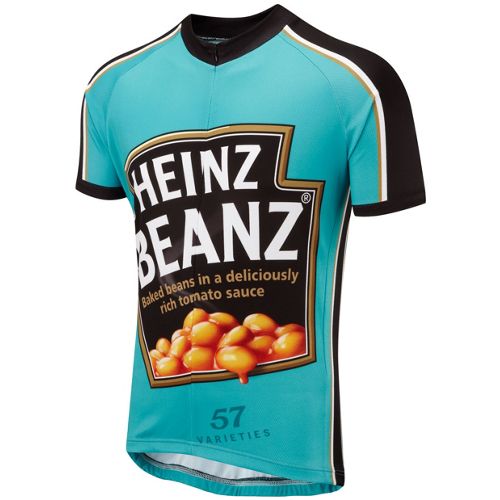
And lastly, the Heinz Beans kit! Yes, a thousand times yes.

Made by Foska Clothing. Please let us know about any funny cycling kits you know of or may own. We would love to hear about them, always a good chuckle.

Tuesday Banter: Shaved Legs vs. No Shaved Legs!

Starting a new series today titled “Tuesday Banter”. Given that Tuesday is my Monday, it is always good to start the week with a bit of playful banter for morale. Ergo, “Tuesday Banter” which shall be fun and sometimes silly topics, that are always cycling specific of course. Today we are going to be discussing the much debated shaved legs versus no shaved legs for aerodynamic efficiency.

Who better to test the wind tunnel than Specialized with their state of the art wind tunnel and aerodynamic efficiency measuring system. Following is a video of the tests that were ran as well as the findings. I have also followed the video with a summation of the findings from specialized.

Specialized explains that they didn’t anticipate the difference in aerodynamic efficiency to be very significant, ergo they have not undergone such tests in the wind tunnel yet. However, after the ‘beard vs. no beard’ test, viewers insistently asked if similar tests had been done with shaved vs. non shaved legs. Therefore it became time to empirically squash the debate.

To ensure reliability of the results, the experiment was tested with 6 different riders. Moreover, the riders were thoroughly tested in the wind tunnel ten times with and without shaved legs to ensure reliability of the results. What was found was actually quite impressive, Chris from Specialized explained. Keith, the main subject of the test, gained nearly a minute and a half over a 40-Kilometer distance. Though Keith was on the high end of the tested six riders, the average still ended up being 70 seconds saved over a 40-Kilometer ride.

This is a huge difference in aerodynamic efficiency. Chris explains that this difference is comparable to that of changing from a traditional round tube frame to a Specialized Venge.

Looks like I have to start shaving my legs, ugh! Feel free to direct any questions our way, unless of course they are about the specifics of the leg shaving process.


Trek model year 2015 road bikes: Emonda, Madone & Domane – first look

Trek model year 2015 road bikes: Emonda, Madone & Domane – first look.

RoadcyclingUK has thoroughly broken down the comparison of the 2015 Emonda, Madone, and Domane. In summation, Trek has created three lines of road bikes in the 2015 year each offering points of differentiation. For cyclists who are most concerned about weight of the bicycle, Trek has introduced the ultra lightweight Emonda. The Emonda SLR10 weighs in at just over 10 lbs. If an aerodynamic race bike is what a rider is after, the Madone series is going to be best suited for their needs. In addition, the Trek Domane dominates Trek’s endurance road line, designed for comfort over long distance rides.

This is not to say that weight has been neglected in the Madone series for example, yet it as not been the main focus in engineering such as it has with the Emonda where the SLR 10 even needs to have weight added to it to meet UCI Race Standards. The article above explains this in depth, a very thorough breakdown. Either way, Trek continues to offer multiple bikes for rider’s various needs as opposed to simply following industry trends which seems so common in the industry today.

https://i0.wp.com/cdn1.coresites.mpora.com/rcuk/wp-content/uploads/2014/07/IMG_3259.jpg

2015 Cinelli Mash Histogram and Parallax Review

The Cinelli Mash has made a well deserved name for itself in the fixed gear market in their years of production. It may appear that Cinelli  simply applies different color schemes to the Mash and Mash Histogram framesets from year to year or from model to model, but as Cinelli reiterates this is far from the truth. I can vouch for this as well, having ridden a number of them myself. For example, the new 2015 histogram pictured below offers the benefits of a tapered head tube, a massive upgrade from the previous year’s model. This tapered head tube comes with a Columbus 1 1/8 to 1.5 carbon fork for match.  This design makes the already agile MASH Histogram more responsive and with better cornering capabilities than ever before. Of course, all the benefits of snappiness and a responsiveness of the Columbus tubing are carried over to the new 2015 model.

CINELLI MASH 2015 HISTOGRAM FRAMESET

Last year the Cinelli Mash Parallax was introduced. This was introduced as Cinelli’s quintessential criterium track frame. Thorough research and field testing with the MASH team has gone into the development of this frame to make it the best race bike for street or track that MASH has ever offered. As with the MASH Histogram, the parallax has a tapered head tube with a Columbus 1 1/8 to 1.5 carbon fork for match, offering the same benefits of responsiveness and better cornering capabilities than any other. Cinelli has used the Columbus Airplane (Supersection oversized shape) 7005-T6 aluminum tubing on this frame, super fast and responsive. This frame is perhaps the most eager ever produced in the MASH line as a result of fine tuning the geometry for race specifics.

CINELLI MASH PARALLAX FRAMESET

All Cinelli Mash frames come with a drillable front fork for mounting a road brake caliper. They also all come standard with fork, a headset, seat clamp, and replaceable stainless steel dropout inserts. Don’t be distraught by the price tag, I can tell you from experience that these bikes are packed with value, and worth every penny. I have never met anyone who has regret investing the money in a Cinelli Mash frame. Upon riding it, you will feel the difference immediately, one of the most responsive, snappy, and eager track bikes I have ever ridden.

Feel free to ask any questions, myself or anyone else here at Fulton Bikes are happy to answer or help with your research and purchase decision in any way that we can. And if you happen to be local to the Brooklyn or the five boroughs area, we have 2015 Cinelli Mash frames in stock.

S-Works XC Shoe Review

Alright, let me start this post by simply stating that these shoes are the bees knees. Those who may neglect the benefits of a carbon sole shoe have clearly not experienced the Ultra-light, asymmetric optimized Powerline carbon sole. This sole advertises a Stiffness Index of 13, and believe me you feel all that in the power transfer immediately as you step on the pedal. Not to mention, this shoe is crazy light. Through stress and pressure testing, Specialized has identified the areas which require reinforcement and those that do not. Ergo with the S-Works XC, they have designed a super light yet ridiculously stiff MTB Shoe.

In my opinion, the next best design feature of this shoe is the Two independent Boa® S2-Snap dials. These dials are easy to use, even when the bike is in motion. Moreover, they are more precise than the ratchet system utilized by other brands. As snug as this shoe fits, the forefoot does is comfortable. This is a feature that I always look for in a shoe.

In my experience, shoes either are not snug enough around the ankle and Achilles and power transfer is lost as a result such as that from heal lift. Or, nearly worse, the shoes are plenty snug yet knacker the forefoot. I don’t know about you, but with shoes that knacker the forefoot, this pain can become intense, therefore slowing you down, maybe even to where you need to stop and take off shoes for 5 minutes, no bueno. I ride the S-Works XC shoe for 100 miles, comfortable and snug the entire time. The Thermobonded, Adaptive Fit upper is designed especially well in this model. Not to mention that the shoe comes in multiple widths as well as half sizes, guaranteeing a perfect fit.

Specialized invests heavily each year in their research and development, specifically in their body geometry engineering. This investment becomes evermore apparent in the quality and fit of their products. With this shoe in particular, the sole and footbed are designed to optimize hip, knee, and foot alignment and therefore increase comfort and ultimate performance. Of course, these may be minor improvements that the novice cyclist may not notice, but advanced cyclists will recognize them. Nevertheless, cyclists at all levels will benefit from these advancements whether they are noticed or not.

I back this shoe 100%, keep doing what you do Specialized, we love it!

Watch the video of the features of this shoe, explained by the Specialized expert here.


Specialized Winter Gear Review

Alright, full disclosure, I am a fan of Specialized equipment and apparel. Yet, as an avid cyclist and ambassador of the cycle industry, as well as an advocate of the brand, I feel the I make unbiased judgment of their product. I would never recommend a product to a fellow cyclist that I felt was rubbish. Moreover, Specialized is neither paying me nor giving me free product. I purchase my equipment and write honest reviews for fellow cyclists who are also spending their hard earned money. As the days get colder out there, of course all of us diehard cyclists are looking for the proper apparel to keep us rolling on two wheels through the winter. This year I have invested in some specialized product to keep me warm through the New York winter. Currently, as we have not hit the frigid winter months of January and February, I am riding the Specialized Deflect H2O Mountain Active Shell Jacket an the Specialized Deflect Gloves. Images of these items are below, and following is my honest review.

http://s7d5.scene7.com/is/image/Specialized/120430?$Hero$http://s7d5.scene7.com/is/image/Specialized/117720?$Hero$

Granted, it has not generally been really cold yet, these products have worked out very well for me. Even those cold nights in November when it hit the low 20s, I was still out riding while others were indoors curled up by their space heaters. The Deflect H2O Mountain Shell works great for layering. Of course, when layering remember to begin with a good base layer that will wick away moister. This is essential because as you ride, you will warm up and sweat a bit in even the coldest of conditions. Ergo, a good moisture transferring base layer will wick the moisture away from your body, preventing you from getting cold later. I recommend the Specialized Merino Layer Long Sleeve for the winter.

Nonetheless, with however many layers I have felt necessary temperature depending, the Deflect H2O Mountain Shell has been great at everything that it advertises. The Gore® WINDSTOPPER® Active Shell breaks the wind, deflecting that super cold bite that Manhattan and Brooklyn are known for, and it effectively deflects light rain as well. Note that this is not a fully waterproof jacket, yet it works very well as a water resistant shell. The vents are perfect for when you start to heat up a bit, and the internal SWAT pockets come in handy surprisingly more than you would expect them to. Even as it has dipped below 30 degrees, I have worn this jacket with a base layer and then a sweatshirt and been plenty warm once riding, anything more and I would have been overheating.

Now, toes and fingertips are always a different story aren’t they. As mentioned, I have been using the Specialized Deflect Glove. Specialized advertises “Deflect offers great breathability and comfortable protection for temperatures down to 45°F/7°C”. And this statement I can vouch for. I have even been riding these gloves in the low 30s and been comfortable with them. In those November nights when it dipped into the low 20s, honestly my fingertips were a bit cold, yet not freezing off. Yet for these temperatures and even colder, specialized still offers three levels of gloves above the deflect, these are the Element 1.5, 2.0, and 3.0. The Element 3.0 is designed to handle even the most harsh of weather conditions.

http://s7d5.scene7.com/is/image/Specialized/113417?$Hero$

The Hydrophobic Ax Suede fit palm of the Deflect gives great handlebar feel, especially for a cold weather glove. The wiretap technology, designed to use smartphones and other touch screen devices, is surprisingly effective. And this is a handy tool to have for those navigating maps or doing messenger work. Yet, my favorite feature of this glove is the Slip-on cuff for minimal bulk and snug fit. I would highly recommend these gloves, and when it gets brick cold out there you can always use the Mesta Wool Liner underneath or of course upgrade as there are numerous other options in the specialized line.

Thanks for reading, any and all questions I am happy to answer.